


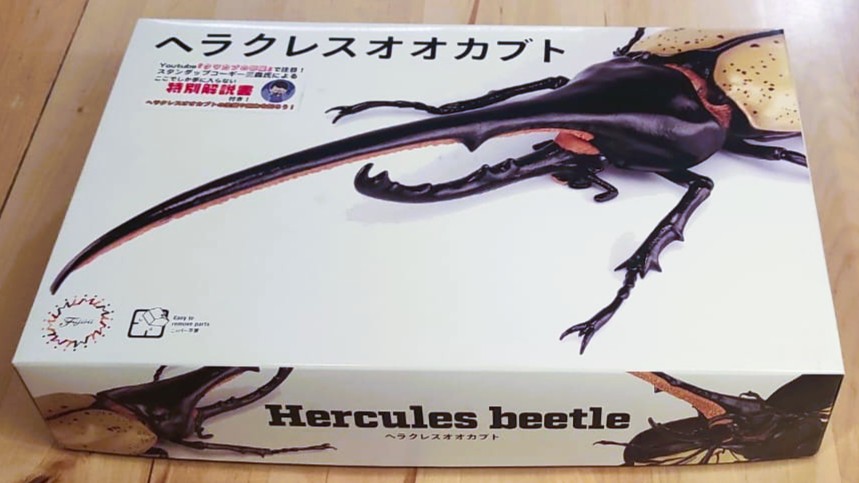
The Japanese model kits company Fujimi Mokei released a series of arthropod models in their Living Things or Living Thing Arc series. All models were released in multiple different colour versions. Two models from the series have already been reviewed on the blog: The Japanese Giant Mantis, Tenodera aridifolia (painted as Chinese Giant Mantis, Tenodera sinensis) by Isurus, and the Red Swamp Crayfish, Procambarus clarkii by bmathison1972. Today we’ll have a look at model No. 26, the Hercules beetle – here in the Standup Corgi Kwakabu Room version. However, the parts and colours are apparently the same as in the regular version.

The iconic Hercules beetle, Dynastes hercules (Linnaeus, 1758) still holds the record of being the longest known beetle species. Which isn’t exactly fair, though: The enlarged pronotal horn contributes to about half of the entire length of a major male specimen. Several other, shorter-horned scarab species of the genera Megasoma and Goliathus can be more massive than even the largest Hercules beetle. Females of the Titan beetle, Titanus giganteus, are the longest beetles when horns are not taken into account. As for record lengths of Hercules beetles, a maximum of 170 mm for wild specimens is generally accepted. The size an individual male will reach is dependent on genetics and, to a larger extent, optimal temperature and nutrition during the larval stage. This is true for many xylobiotic beetle species with larvae feeding on decaying wood and explains why they often show a vast size range with the smallest males being only about a third of a major specimen’s length. During the last few years, exceptional captive-reared specimens have surpassed even the documented maximum length for wild specimens. As of today, the official record accepted by Japanese beetle enthusiast magazine “Be-Kuwa” is a specimen from 2024 that was confirmed at 183.5 mm. Before that – and when the model kit featured in this review was released (in May 2023), the official record was 182 mm. Let’s keep that latter number in mind…


A 2017 paper by Jen-Pan Huang revised the phylogeny within the genus Dynastes using a combination of molecular, morphologic, ecological, and geographical data and elevated ten subspecies to species level. The nominate subspecies, D. hercules hercules, would then just be D. hercules, without any subspecies. Following this revision it would still be the largest of them all but with a limited geographical distribution restricted to Guadeloupe and Dominica in the Lesser Antilles. This specific Hercules beetle is distinctive for the lateral hornlets on the sides of the pronotal horn located further forward than in the other subspecies/species with the exception of D. lichyi from the eastern Andes. However, the latter has a conspicuously enlarged, hooked tip of the cephalic horn.


The model kit clearly shows the morphological characteristics of the nominate subspecies (or true D. hercules following Huang 2017) and comes in a cardboard box measuring 322*206*63 mm (12.68*8.11*2.48 inches). Included are 41 parts distributed over nine runners. Most parts are made of polystyrene, however, many of the ball-joint parts and their corresponding sockets are made out of a softer material, probably polyethylene, which is less prone to breakage. While most runners are glossy black, the elytra are beige, the fringe of setae on the underside of the pronotal horn and a tuft of setae at the tip of the abdomen are cast in orange, while the hindwings are made of translucent yellow. While it’s not a necessity to paint the model, in its unpainted state it would not look too convincing.

Assembly was very easy and did not require any glue. The finished model shows great detail and is on par with the Bandai Diversity of Life versions representing this species. The Fujimi model has 14 points of articulation and allows moving the head, prothorax, legs, elytra, hindwings and some abdominal segments. The hindwings can be attached for flight display or they can be taken off to show the beetle in a perching position with the elytra closed. When I read that the model was, according to the manufacturer, 200 mm long, I was actually a bit disappointed because I would have preferred it to be somewhat closer to life size. Well, I’ve never been one to blindly trust any measurement I haven’t taken myself. After assembly, I noticed that they were apparently including the hind tarsi in those 200 mm. Measuring in direct line from the tip of the pronotal horn to the rear margin of the closed elytra I got – could it be? – 182 mm. Exactly what was the accepted record size at the time the model was released! That’s probably no coincidence since the 182 mm record specimen is even mentioned on one of the info sheets that were inside the box.


When the hind wings are attached the wing span is approx. 215 mm. While I knew it would take a few hours I was always going to paint the model. It’s not that Hercules beetles have a difficult colour pattern, anyways. Head, pronotum, legs, and most parts of the ventral side were left unpainted, though, as they were already shiny black. However, the fringe of setae that was going to be attached to the pronotal horn would have looked very unconvincing as a uniformly orange block. So it had to be primed, painted black, and then drybrushed with different yellow and orange acrylic colours. The elytra were primed, coated with a mix of yellow and ochre, and black margins and spots were added before a glossy clear coat was added. As a template, I used photos of male specimens from my own breeding and decided I wanted to recreate the elytra of a medium sized specimen I reared in 2020 which had quite yellowish elytra with only few dark spots. The hindwings were partially painted with alcohol based pigment pens along the veins with a little translucent chestnut brown around them.


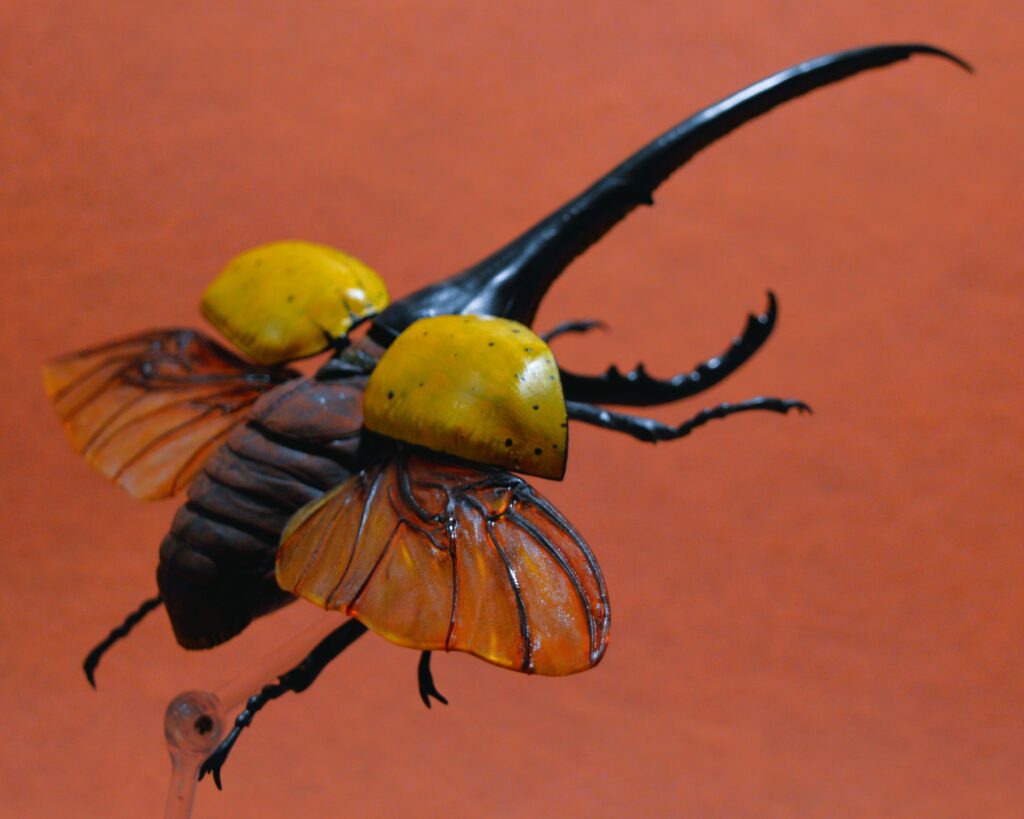


It is an aesthetically pleasing, detailed model kit, deliberately representing a (former) record-sized Hercules beetle with extremely long horns, yet it represents actual life size and proportions. It surely benefits from painting and I’d recommend investing a few extra hours to everyone who acquires it. The regular price is a bit steep though, I think the suggested retail price was close to ¥5,000. I ordered mine for much less when it was on a discount for just ¥1,350. A stand is not included. However, for displaying the model in flight a display stand like the one in the photos is definitely recommended.


