


To start the new year, I decided to go back to a favorite group, the bichirs. If for no other reason, to get three bichir reviews on the blog, and get that strange little group into the fun stats listings on the Animal Toy Forum (available here)! And it’s from a company, and series, that may be less familiar to many people, a company called Favorite out of Japan (formerly distributed as Kinto). They are generally known more for their prehistoric models but do have a notable, if small, range of modern animals—especially fish, and in this case, a collection featuring a number of primitive fish species called Ancient Fish (not an especially creative name I guess). And within that collection are a few different lines—in the case of this model (and 5 others), they are called ‘Soft Models’, figures that are solid PVC, somewhat stiff, and modestly large sizes, but not as large as the Vinyl models, which are best described as huge, and somewhat flexible (so…softer than the Soft Models. Not confusing).

So, while there are a few other saddled bichirs Polypterus endlicheri on the blog, there are none as large as this one (at least, as what we might call toys). This does mean that I don’t really need to dig into the species too much since I think I covered enough after not just one but two different saddled bichir reviews. I’ll stick mostly to describing the model instead. One thing about it, the size of the figure, at about 18.5cm (7.2 inches) long, is a better reflection of this bulky species of bichir that can reach up to 76cm (30 inches) long. This gives a scale of around 1:4 and looks at least the size of living polypterids I have and do keep (including, at one time, P. endlicheri, but not now, but it was twice that length) but a relatively small specimen of a saddled bichir.

The figure itself is sculpted laterally quite straight, with a gentle recurve to the right. The overall body is tubular, widest and roundest in the middle, with the head more dorsoventrally flattened and the caudal peduncle more laterally compressed into the tail. Vertically, the figure is sculpted horizontal, however the model is posed on a chunky wood-looking base that has it positioned pointing downward a little at the snout. The base is attached by inserting a tip into a hole in the belly. This might not be popular with some collectors that don’t like bases*, but on display it gives a natural dynamism that looks like the fish cruising over the substrate. *but see at the end of the review…


The fish is depicted with the dorsal finlets fully erected, with the spines nearly vertical and the branching rays (lepidotrichia at the top, and secondary rami down the spine) extending fully back; within these are the thinner fin membranes. The finlets are well-differentiated, only pushed close together right at the bases. This is a pretty typical look for a fish in mid-water cruising mode; if it were darting away the finlets would be down. The size of the model really allows for the fins’ structure to be visible, something that at best is vaguely visible on the much smaller models like the Colorata or Bandai (and honestly difficult to see for the real animals as well).

The paired fins are all extended outward, with the characteristic fleshy fin lobes. Both the pectoral and pelvic fins have distinct radiating fin rays giving a circular appearance. The anal fin, also having the fleshy lobe, is very pointed and somewhat narrow, and rests close to the lower margin of the tail fin. Given the shape, this would indicate the figure is a female model (males have wider anal fins). The tail fin is appropriately diamond-shaped, but asymmetrical, giving what is called a diphycercal appearance (internally, the skeleton is heterocercal), fully extended out with slightly thicker rami interspersed with smaller rays. All fins have distinct thinner membranes within, all of which are opaque.
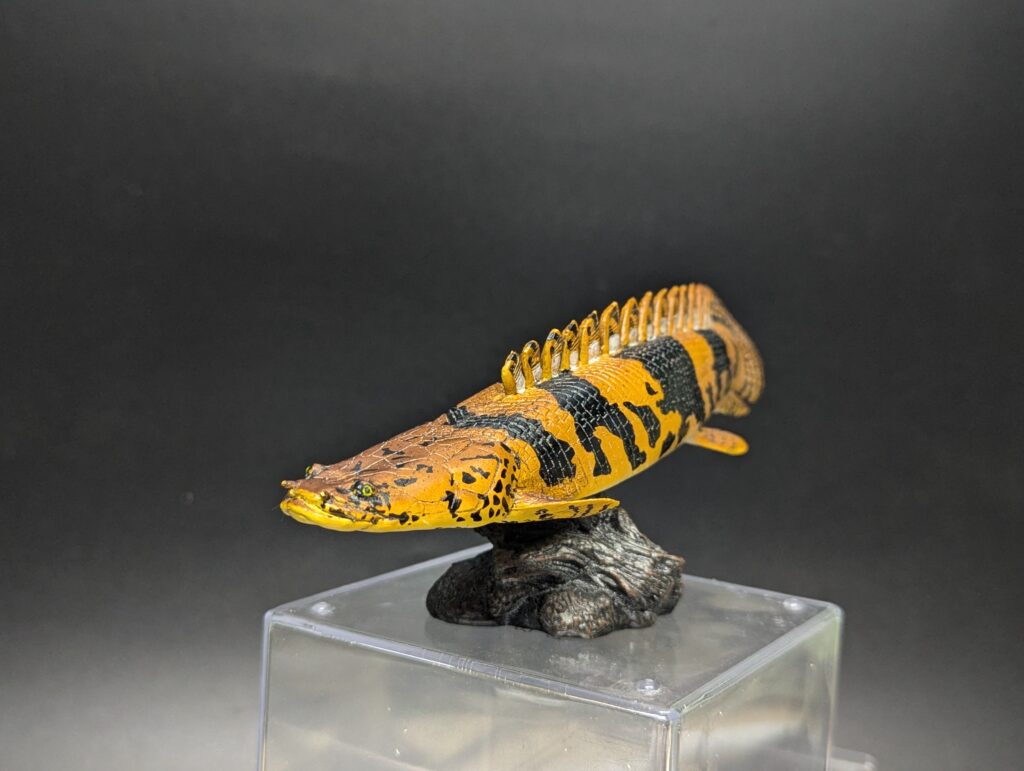

The texture of the body is amazingly well-sculpted, possibly aided by the larger figure size. The distinct ganoid scales are incised with just a little depth and vary at various parts of the body. Just behind the head the scales are a little rounder and slightly smaller, increasing in size along the back to the first dorsal finlet. Fun thing, on saddled bichirs there are 11-15 scales before that first finlet, and if I count correctly, there are fourteen on the figure, so that’s rather good. Along the back and body, the scales are more uniform in size and shape, all roughly rhomboidal with thin edges between them. The belly is also fully covered in the same larger ganoid scales, and the fin lobes are covered in smaller scales.


The head is filled with details. It flattens from the opercula, down to the tip of the mouth which is oriented as superior, with the lower jaw extending furthest forward with a thickened lip and the opening facing upward. The underside of the jaw is fairly smooth, with a few distinct joints for the gular plates. The head is covered in a number of seams as we see in the live fish. Behind the eyes we even have series of small plates where the spiracles are covered (these lift slightly when breathing at the surface). The nostrils are pointed and thin, extending forward from the upper jaw. The eyes bulge outward from the top of the head, kind of frog-like. The lenses bulge slightly from there—they stand out as shiny, yellow orbs with black centres. The opercula have a rounded margin, slightly raised from the body where they meet the body. Overall, the head gives a distinctly alert look to the fish in keeping with the general pose and shape.
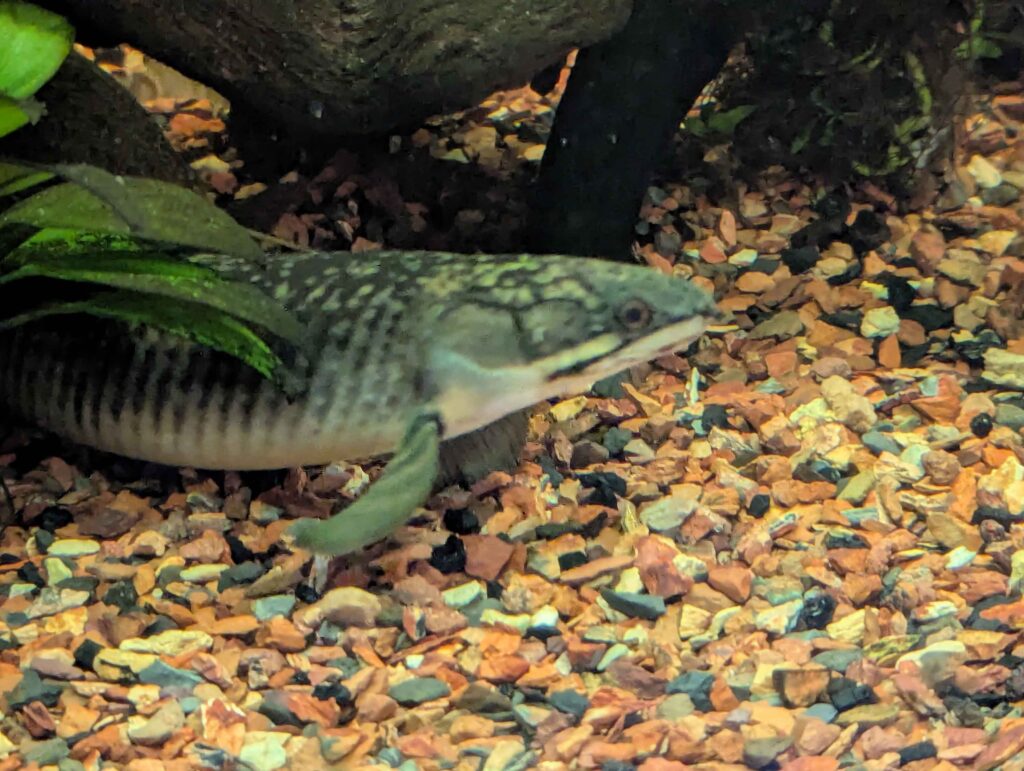

The colouring of the fish is very deep and bright, a little richer than what we’d normally see in the live animal, which is usually a more muted sand or light brown. Overall, the finish is a semi-gloss, the kind of shine that is more likely on an animal outside the water. The base of the body and sides, including the head and fins, is a dark orange ochre, slightly darkening at the back with a bit of an ombre to a lighter shade down the sides. The top of the head is shaded just a little darker than the back. At the very margin with the belly is a slight yellow shade, working into the belly as a more solid ivory colour. The ventral surface of the paired fins are also a lighter yellowish hue.


The markings on the body are all a solid black—from my experience they’re usually a darker grey or shaded as opposed to the distinct margins, but nothing wrong with bold depictions. That’s actually typical for most fish figures, where the colouring is often more ‘idealized field guide’ than ‘what it looks like in real life’ but I digress. Bichirs often have some kind of elaborate markings, but something about the saddled bichir seems to really speak to figure makers. The most prominent marks are the thick bands—or saddles— crossing over the back and down the sides of the fish, which are quite wide. At about the mid-point on the sides the saddles break up a bit, first by forking into two irregular lines, then splitting into a few broken spots. Other spots, dashes, and blotches can be found at the bottom of the sides.
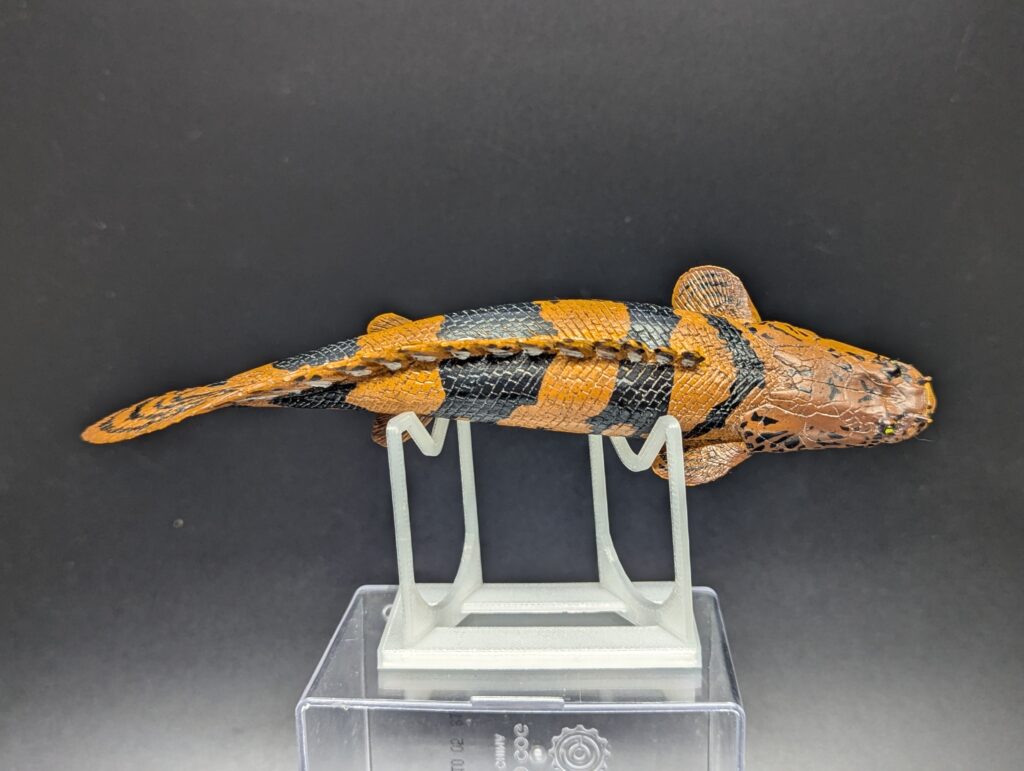

There is another thinner band that crosses behind the opercula, and a few other long blotches along the caudal peduncle. The ventral fin lobes all have tiny spots. The dorsal surface of the paired fins have faint black radiating lines, while on the ventral surface, the radiating lines are darker and more prominent. The anal fin has a series of black vertical stripes. The tail fin also has four darker radiating bands roughly following the shape of the fin. The spines and rami of the dorsal finlets and the ochre color, with black spots irregularly placed on the upper end of the finlets. The membrane below the rami is a white wash, which honestly looks strange—possibly meant to represent the semi-transparency of the fin but just kind of sticks out. The head, opercula, cheek and even the lips have dashes and spots, largest on the opercula. There are even a few spots on the underside of the jaw. In general, the pattern, like the sculpt, is a good representation of a saddled bichir’s markings; there’s a lot of regional and individual variation, so it would be tricky to provide the ‘irregularity’ we might expect in a mass-produced model.
To sum up, i this is a great model of a remarkably interesting (especially to me) type of fish. Would be nice to see one of the many other species someday, but saddled bichirs seem to have a special place with many keepers, especially in Japan (where they were first successfully captive bred). The line overall seems to have stalled after 6 species in the Soft Models (and only one Vinyl), but we can hope. More species in the line would be good, and there are several more ‘ancient fish’ that could use figures for fish collectors. Like most of Favorite’s models, they are most accessible in Japan although there are sellers that carry the prehistoric models, maybe they’d carry the ‘prehistoric’ fish as well—they’d certainly stand out. Because the whole line is very impressive (maybe I’ll get to the others eventually.) But that said…
BONUS CONTENT! Saddled Bichir by Oenux

I did mention there would be something notable at the end, but it is more fitting as an appendix to this review instead of giving it one on its own. Many collectors are aware of off-brand models, especially through sources like AliExpress and Temu, and this bichir is indeed one that shows up. A lot. One company name in particular seems to come up, with figures that are often modeled from familiar makers, but many times with slight variations—differently painted, differently sized, sometimes even differently presented—is Oenux. I honestly don’t know if they are knock offs, re-licensed molds, repainted seconds, or what. I do know that they are becoming more common. And in the case of the Favorite Ancient Fishes, the whole series appears to have been copied, including the bichir.

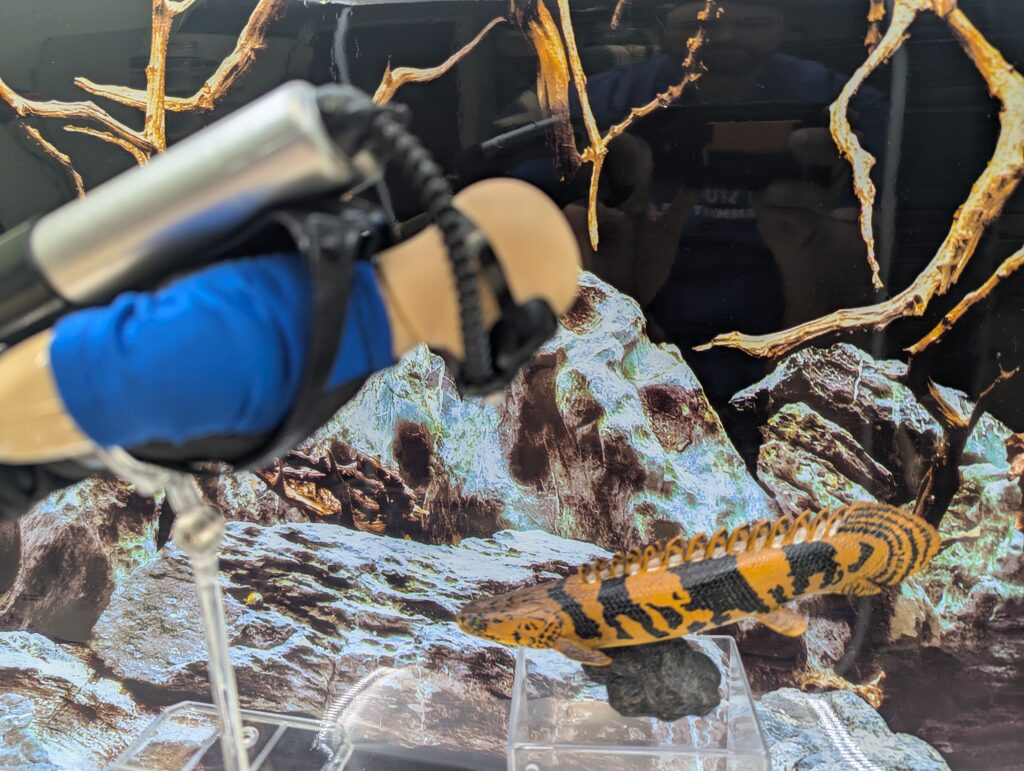
Yes, I have one—I had to know how it would compare. One thing that immediately stands out—it has no base, and no hole for a base. There are no company markings on the figure…but that is true of the Favorite model as well, where the company details are on the wood base. But they do have the bichir with a base as well (I didn’t bother with that, don’t know about markings there). This is true of all the Ancient Fish models too—with or without bases, both are available. The paint scheme is very close to the original, just a little more brownish than the original with more muted black markings, and not as much facial marking. Unlike the bichir model, some of the other Oenux fish models are repainted in several different ways to represent different morphs (notably the Asian and South American arowana figures).

There are also small details in the sculpt that are only truly obvious if you have both. The length is a clear one, with the Oenux being 17cm long (so, scale 1:4.5) but again only in side-by-side comparison; looking down, the Favorite is also wider. From the side, the head is a little less horizontally compressed than in the Favorite figure. One more detail stands out only for the truly nitpicky—the paired fin membranes are sculpted against the body on the Oenux, instead of fully extended from the body as in the Favorite. The figures also feel different—the Favorite has more weight, and the hand-feel is…different. The Oenux might be described as soapy? I don’t know how to define it. There’s no residue or anything, just a different finish. So…it exists, it is slightly different.

For me there’s an awkward grey area of how to approach these figures. I would recommend the Favorite first of course, but I had the choice and the means. The price points are very different, and the Oenux is readily available to anyone, anywhere, which is also something I support. Some parts of the world simply cannot get figures from Japan, but many online retailers sell Oenux worldwide. The Oenux I am familiar with are well-beyond serviceable; these are not your ‘dollar store’ quality bootlegs. The price difference means a Favorite would never (normally) be given to kids or schools or education kits, but the Oenux would, and budgets are tight everywhere. I’ll leave it to each collector to decide, but I will say, Oenux models are starting to get a lot of presence in gift shops and other stores (again, budgets), so be aware. Also be aware, the Oenux bichir is often listed as a ‘delhezi’ bichir, not a saddled. I’ve kept both species, they are vastly different looking—and side note, my first live P. endlicheri was sold to me as a P. delhezi (30 years ago, but it still happens) so it’s not just toy sellers. But if someone would make a delhezi, I’d be down for that!
