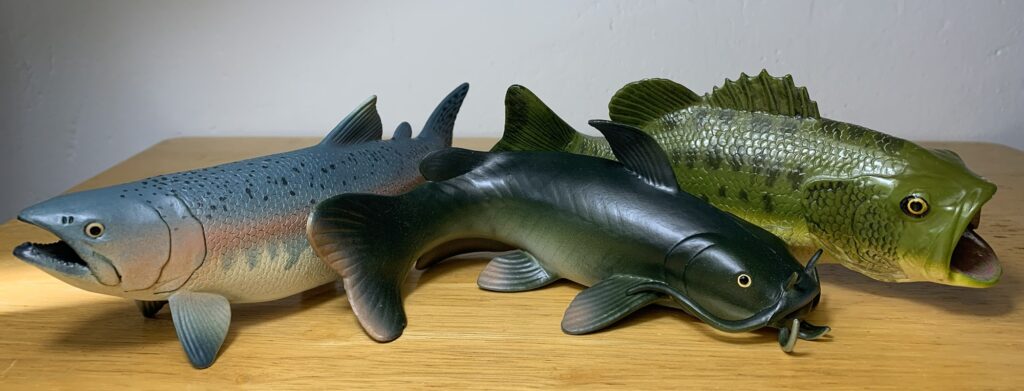
Last week we looked at the Safari Ltd. “catfish” which Safari was kind enough to identify not at the species level, or even family level, but at the order level. An order containing 3,000 species. The figure was pretty easy to identify but it does beg the question, why doesn’t Safari identify it more precisely on their website? They commissioned it after all. Well today we’re looking at another loosely identified fish from Safari, the Incredible Creatures salmon, from 2019. Safari’s site claims it is from the “family Salmonidae, particularly genus Salmo and Oncorhynchus”.
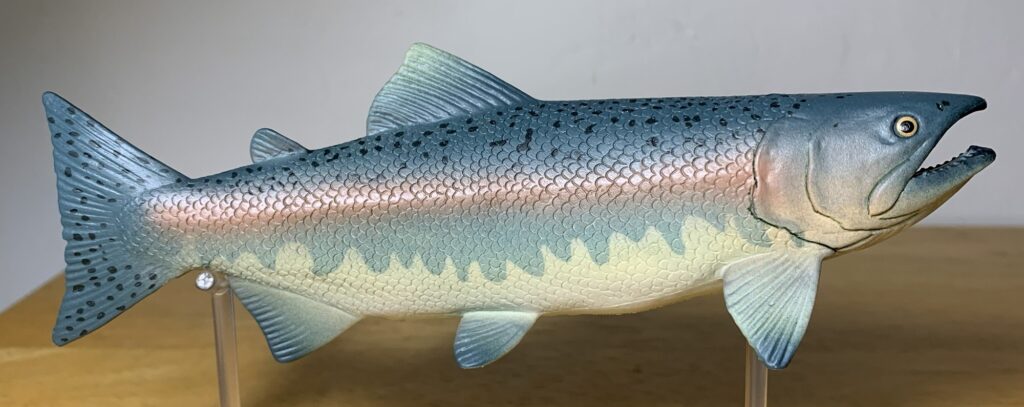
ToyAnimalWiki identifies this toy as a chinook salmon (Oncorhynchus tshawytscha), but I don’t like to take their identifications at face value, sometimes they’re wrong and trying to identify figures gives me an excuse to dust off my college textbooks and fish identification keys. I think a strong case can be made for a chinook salmon but I also think that the pink salmon (Oncorhynchus gorbuscha) is a viable option.
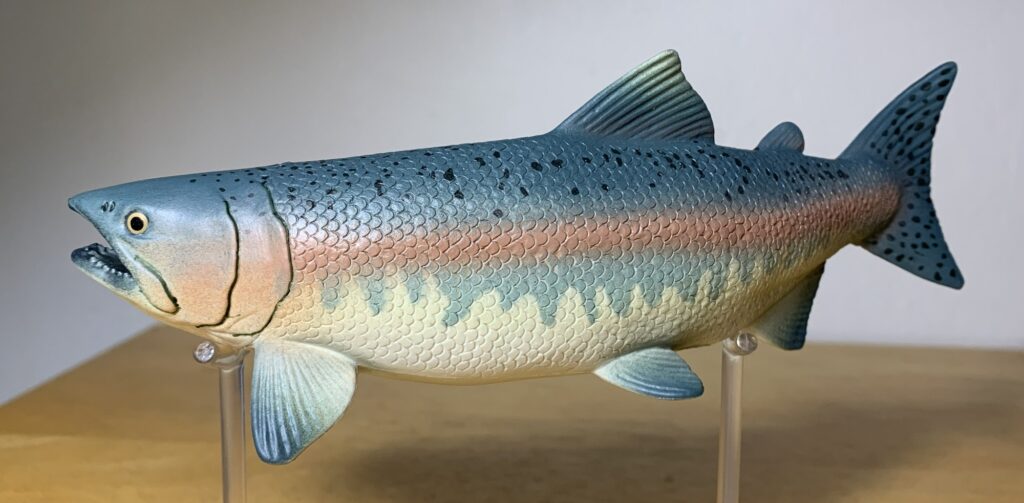
The figure could casually be identified as a chinook salmon solely on the basis of the inside of its mouth being dark colored. The lower jaw and gums are black in chinook salmon, giving them the other common name of blackmouth. But the dark color here is just a slightly darker shade of the teal color used elsewhere on the toy. That basically means it is unpainted and probably useless in confidently identifying the toy.

The figure has irregularly shaped black spots along the back, above the lateral line, and across the entire caudal fin. Species like the sockeye and chum salmon have no spots and can thus be ruled out. On the coho salmon’s tail they’re restricted to the upper caudal fin. That said, the pink salmon, and rainbow trout aka steelhead salmon has spotting in these areas as well as a red or pink streak along the flanks, like this toy. In fact, the overall color is not very indicative of the chinook salmon at all. Chinook salmon are blue, green, or gray above with silvery sides and bellies in marine waters and reddish-brown or maroon when in their freshwater spawning colors. The toy is also missing spots that should be on the dorsal fin which makes the distribution of spots more similar to that of the pink salmon, which also lacks spots on the dorsal. The size and shape of the spots would be inaccurate for a pink salmon though, which have larger and more blotchy spots, especially on the tail.

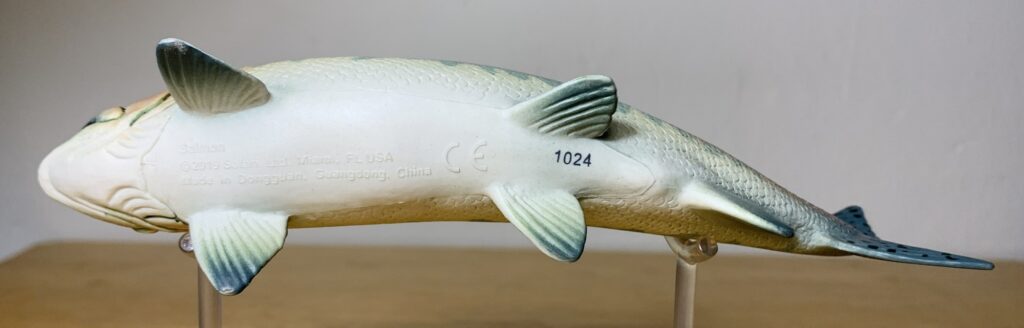
To rule out the steelhead salmon we have to turn to the anal fin. The shape of the anal fin can be used to tell all Pacific salmon from rainbow and cutthroat trout. In the latter the anal fin has a shorter base, with the longest ray equal to or longer than the base, so that when the fin is folded the tip touches the body past the fin base. In Pacific salmon the fin base is longer than the longest fin ray, so that when folded the tip of the fin rests near the middle of the fin base. We cannot compress the fin on a toy, but we can eyeball it well enough to determine where the fin tip would touch, ruling out the rainbow trout/steelhead salmon. So, if you’re identifying the figure based on the size of the spots and color of the mouth, it is a chinook salmon. If you’re identifying it based on the distribution of spots and colors, it’s a pink salmon.

The chinook salmon is native to the north Pacific, from Alaska to California in the eastern Pacific and from Russia to Japan in the western Pacific. They have been widely introduced elsewhere however, including to the Great Lakes, Patagonia and Argentina, and New Zealand.
The pink salmon is the most abundant species of Pacific salmon and can be found from the Mackenzie River in Canada to California in the eastern Pacific and from Russia to North Korea and Japan in the western Pacific. They have been introduced elsewhere however, including to the Great Lakes, Iran, and Europe.

Also known as king salmon, the chinook is the largest of the Pacific salmon. They average 28-40” (71-102 cm) and weigh 10-25 lbs. (4.5-11.3 kg) but they can reach up to 58” (150 cm) and 130 lbs. (59 kg). The Safari figure measures 6.75” (17.15 cm) in total length which puts it at 1/3.6-1/5 in scale for an average sized salmon and 1/7.5 in scale for a maximum sized individual.
The pink salmon is the smallest of the Pacific salmon. They average 18-24″ (46-61 cm) and weigh 3-5.5 lbs. (1.4-2.5 kg). If the figure is a pink salmon then that would put it at 1/2.6-1/3.5 in scale. The figure is posed with a gentle rightward curve in the body and supported by its pectoral, anal, and caudal fins. Unlike the Safari Ltd. catfish and largemouth bass, the figure is hollow.

The anatomy and detail work on this figure is decent enough that I won’t have to nitpick it to death like I did with last week’s catfish, but I will point out that the dorsal fin is placed too far back. The head is smooth with sculpted teeth in the lower jaw and two pairs of nostrils. The details of the operculum are decent, with sculpted branchiostegal rays along the throat. The cycloid scales along the body are small and fine and in size would favor the chinook salmon over the exceptionally fine-scaled pink salmon. The lateral line is not highlighted. The fin rays look good but are etched into the adipose fin when they shouldn’t be. A common mistake on fish figures with adipose fins.

The figure is teal with a pale underside and has a pink streak running through each side. Where it ends, the teal has a bleed down effect along the flanks. A pink blush is also evident over the operculum. The tip of the dorsal fin has a pale tip while the pectoral, pelvic, and anal fins have pale bases with teal colored tips. The eyes are yellow with black pupils.
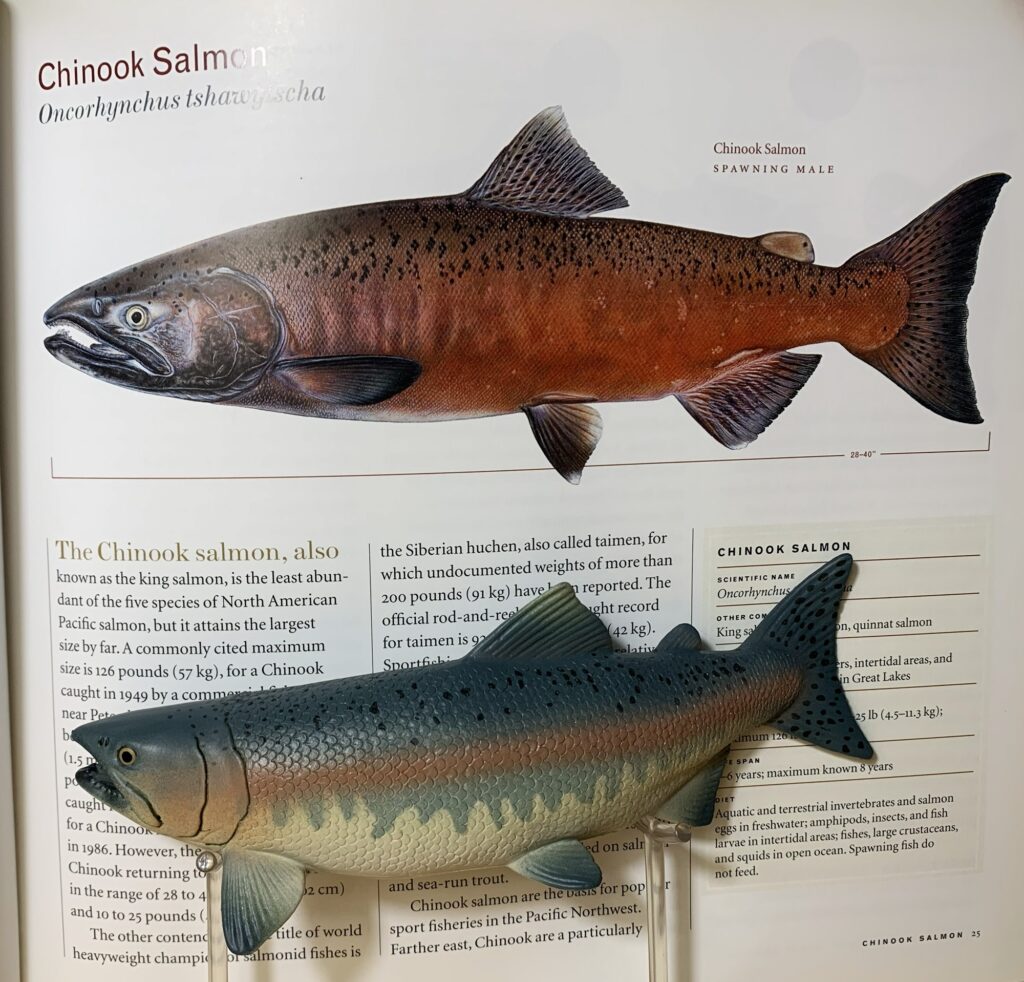

This paintjob doesn’t match the chinook salmon well. Spawning chinook salmon are almost entirely maroon colored with olive-brown heads and backs. The colors here are a better match for a spawning pink salmon than a chinook. That said, spawning pink salmon males have a pronounced hump on their backs so if the figure is a pink salmon then it would have to represent a female.


The Safari salmon is a competent figure on its surface, and clearly represents a salmon, but it fails to adequately capture the look of any particular species. While I love that Safari is producing figures of freshwater fish species (or anadromous, in this case) I do wish they would be more diligent with them and employ the same attention to detail that they’re well regarded for with their other figures. I expect more than just a generic looking salmon from Safari. I recommend this figure to fish collectors, but somewhat begrudgingly, and mostly because salmon figures are uncommon. It would be a good figure to have repainted.