


They say that everything is bigger in Texas and while the breed of cattle that carries the state’s name does possess an impressive set of horns it’s actually an obscure breed of cattle from Africa that boasts the largest horns of any cattle breed. In addition to being long, with a spread of up to 8’, the Ankole-Watusi’s horns have the largest circumference of any cattle breed. According to the Guinness World Records, a bull named CT Woodie had a horn circumference of 40.7” (103.5 cm). The maximum circumference for a Texas longhorn is about 19” (48 cm). Indeed, the horns of the Ankole-Watusi are so absurdly large that it’s difficult to believe they’re real. If you’ve only ever seen an image or two of the breed you might think they are doctored or generated by AI.

Ankole are a group of eastern and central African cattle with the Watusi being the strain of Ankole native to Burundi, Congo, Rwanda, Uganda, and parts of Tanzania. Ankole cattle are part of the larger group of breeds known as Sanga cattle, which are all of the cattle breeds indigenous to sub-Saharan Africa. In Africa, Ankole-Watusi are raised for both milk and beef but outside of Africa they’re mostly kept for their novelty. They’re a hardy breed that can tolerate hot weather, partly with the aid of their horns which can shed excess heat.

Today we’re looking at the Watusi bull by Safari Ltd. Released in 2020, it is the only modern Watusi figure not made by CollectA, which produced a bull, cow, and calf in 2014. Safari’s figure stands 3” (7.62 cm) tall at the shoulder (not including the thoracic hump) and measures 5.5” (13.97) from nose to rump. An actual Watusi bull stands 60” (152.4 cm) at the shoulder and weighs 2,000 lbs. (907 kg) on average. Cows stand 54” (137.16 cm) at the shoulder and weigh 1,500 lbs. (680 kg). This puts the Safari figure at 1/20 in scale.

The figure is presented in a static pose with the head looking leftward. All the hallmarks of the breeds are accurately conveyed here and include long legs, a small thoracic hump, a long, ropelike tail, prominent dewlap, sagging brisket, elegant build, and of course…the horns.

There are a lot of fine, lifelike details to be appreciated here. The horns are nicely textured with rings around the base that give way to grooves along their length. There’s even a metopic ridge on the forehead, which is a bony prominence along the forehead’s midline where the frontal bones meet. This is something that is not always visually prominent on cattle, but its inclusion here shows an extreme attention to detail, with the hair even parting along it.
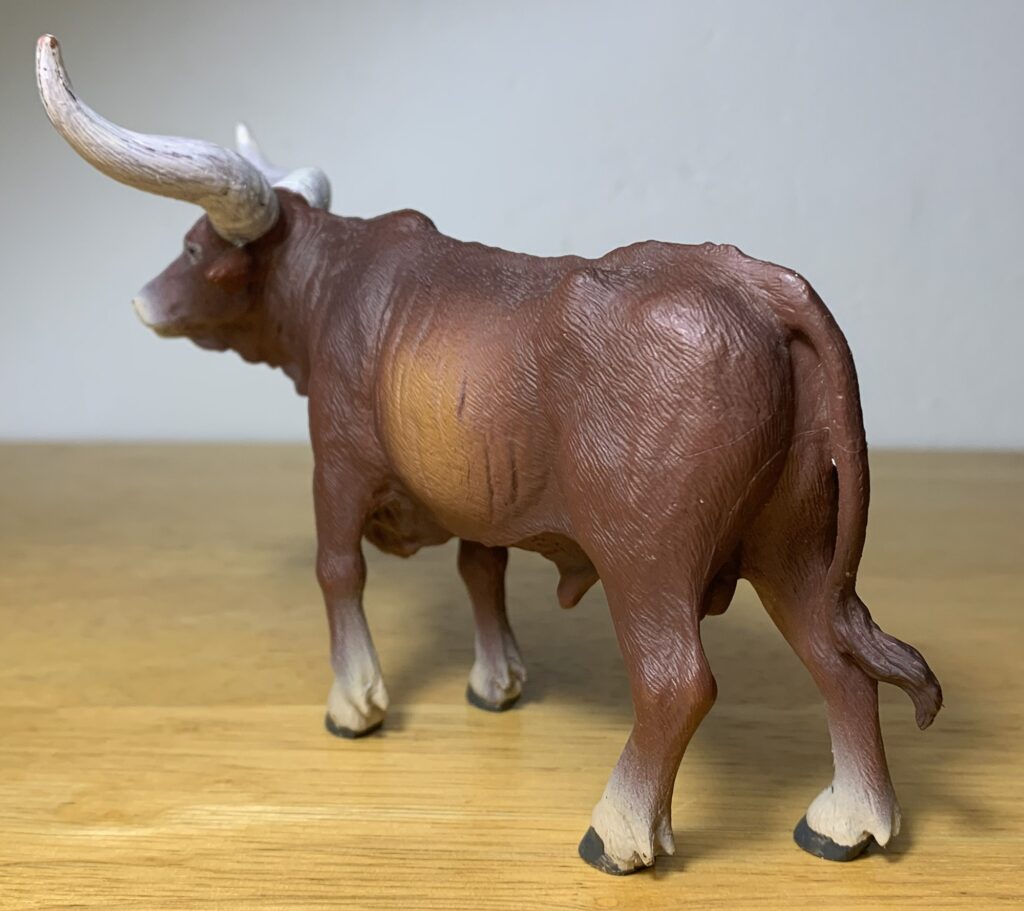
A low ridge runs along the back of the figure that is irregular in shape, with little peaks and valleys along it. The hip bones can be seen protruding and in cattle-speak these are known as the hook and pin bones. Fine hairs are etched in along the body and faint skin creases can be seen where appropriate, mostly along the neck and torso. The limbs are lean and muscular. The dewlap and brisket appear wrinkled and loose. Being a bull, there is a sculpted sheath and scrotum.

The figure is deep red in color with beige at the base of dark gray hooves. The shade of red is pretty uniform throughout but is paler around the sides of the belly. The horns are bone colored with a gray wash and the muzzle is beige. The eyes and nostrils are glossy black, and the eyes are ringed with beige. Ankole-Watusi cattle are generally red but can come in a variety of colors and coat patterns. I think a spotted or speckled coat would have been more eye catching but there’s certainly nothing wrong with this one and the paint application is decent overall.


This is only my second cattle figure from Safari with my first being the angus cow that I reviewed previously with high praise. I don’t know who sculpted this toy, but it is of a similar style and quality to that angus cow, which is to say that the Safari Watusi is a fantastic figure and a highlight in my cattle collection. The CollectA models of this breed appear quite good too, so although there aren’t many Watusi figures out there at least what is out there is of high quality. Whatever your preference I think you’ll agree, no cattle collection is complete without this distinctive breed.
