


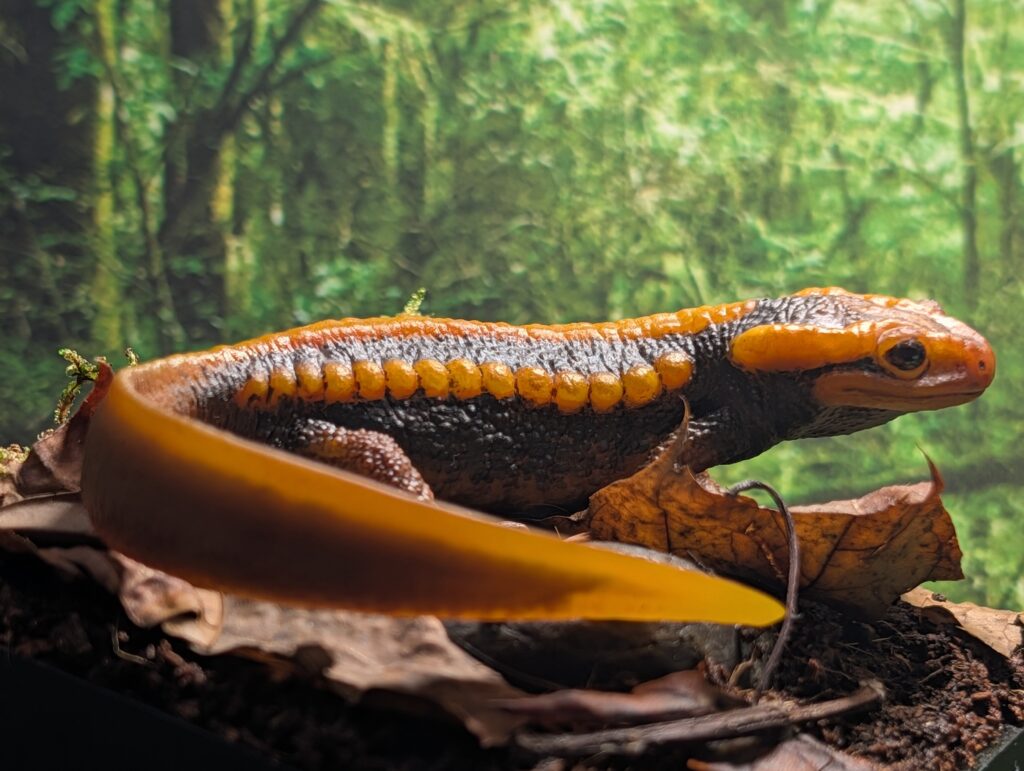
I am taking an extremely broad approach to this year’s ‘Spooky Season’ with this one, but I’ll get there. First, full disclosure, this is not a figure most people will ever get hold of, at least like this. It has been 3D sculpted and printed from Hellbender Museum, although the artist seems to have limited his personal production these days (but you can see his work in some recent full scale museum models and a Safari figure, so good on him!). It’s an existential ‘scary’ for collectors because you never know how fleeting something can be…
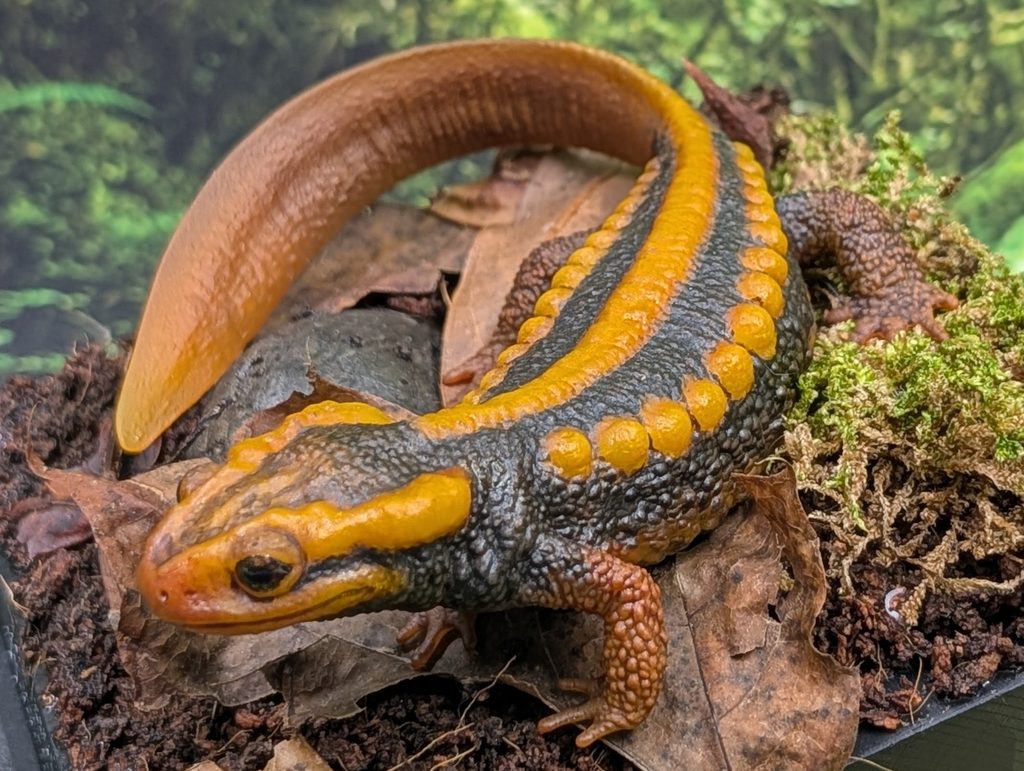
The animal is the emperor newt or mandarin newt, Tylotriton shanjing. This particular figure I have is one of very few painted ones, set up in a diorama, which I got for a ‘bargain’ when he was moving…there are some sites where people print or list stl files, but this particular model hasn’t shown up on most of those. So, I get scared handling it…even if it is in a protected case! But in an actual scary sense, the colours on this animal probably reveal the ‘spooky’ nature of the actual animal and are highly appropriate for the season.

The emperor newt is a modestly size newt, around 20cm (8 inches) in length, found in south China. They are found in higher mountain elevations, in and around pools and slow-moving streams. Their diet consists mainly of invertebrates, especially worms and arthropods. I can recall a time when they were fairly common as pets in shops, but like other salamanders and newts, I don’t really see them as much anymore. Part of this might just be that newts can be tricky to keep as pets, and many populations are under pressure—the emperor newt is listed as Vulnerable. But they are still around to an extent, if you know where to look, often through captive breeding.
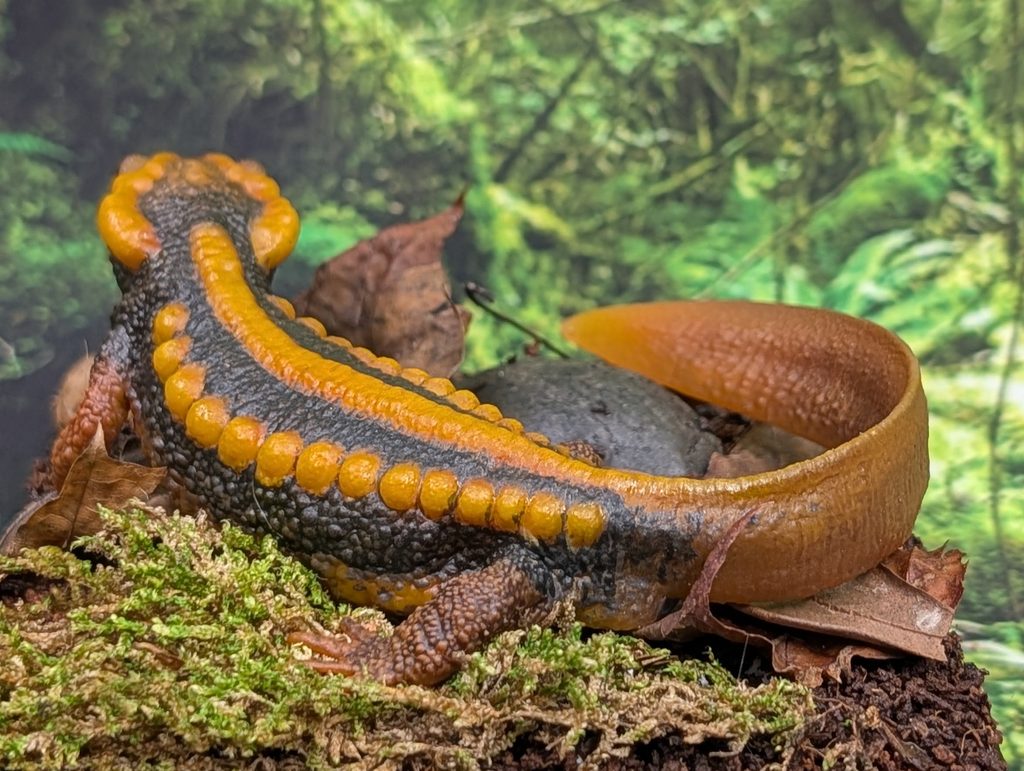
The other reason that they might be less common might be hinted at by their unique, Halloween-themed colouration, a body that is coloured deep brown or even black, with bright, ‘look at me’ orange along the tail, head, and notably along the sides in little bumps. These bumps belie a secret, highly toxic defense mechanism, with each bump containing a poison that can be pushed out by the ribs. And this toxin can be quite dangerous, especially to small animals that might considering preying on them. Less so in people (unless you eat one?) but highly toxic animals aren’t usually great as pets. But really, handling animals like newts is usually riskier for the animal anyway (wash your hands first).

The figure from Hellbender Museum is probably as life-like as a figure can get. It’s tricky to measure, as it is attached to its base, but is about 19.3 cm (8 inches) long, making it 1:1 scale. The model is depicted walking on a small patch of ground, curled in a U, on some moss and leaf litter. The materials were foraged and then baked to prevent mold or pests. But some of the leaf matter can crumble if I’m not careful. Fortunately, the whole thing is mounted in a small display box with cover, so it stays dust free and doesn’t get bumped.

The head of the figure is raised up, with the forefeet turned inward and lifting the body. The hindlegs are more sprawled outward, so the hind part of the body rests on the ground. Behind that, the vertically compressed tail curves around to the right of the body, ending in a rounded tip. The mouth is closed and eyes are large and bright. The closed mouth is indicated with a shallow groove, and the nostrils are present as two tiny divots on the tip of the snout.
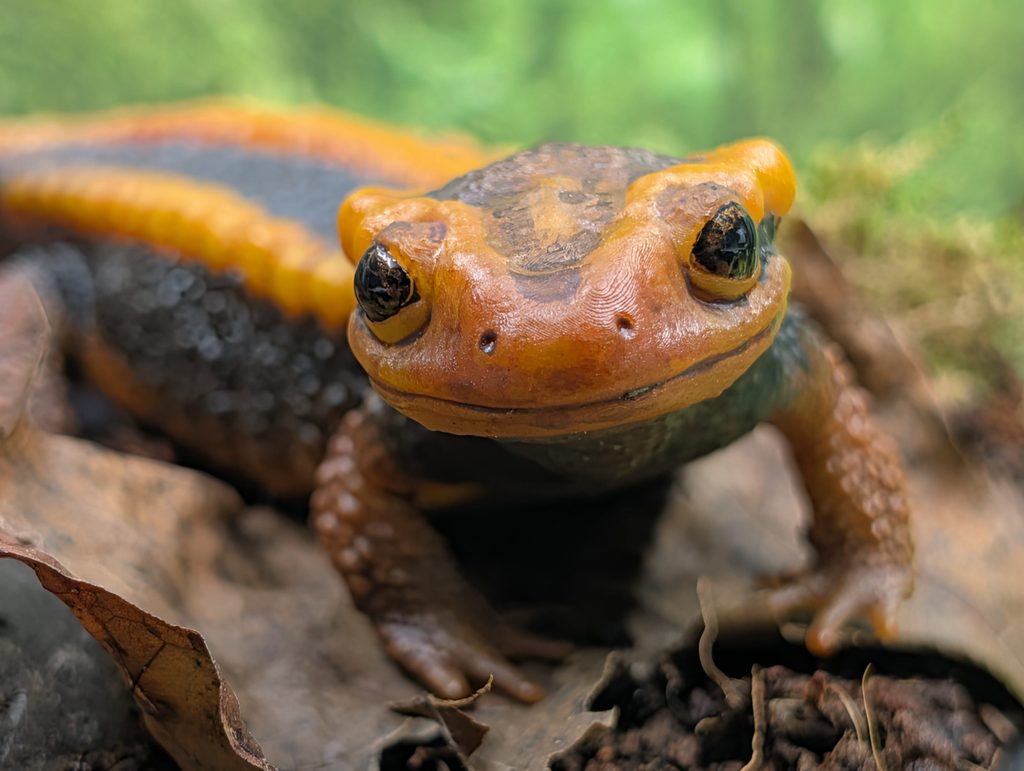

There are four toes on the front feet and five on the hind feet, which is correct, all ending with rounded tips and no claws. The sides have the costal grooves sculpted in, although shallow and tricky to see. The tail is blade-like, thicker in the middle, with a thin, pronounced ridge around the top and bottom, meeting at the tip. Almost eel-like.

The overall skin texture is lightly pebbled and rough along the head, back, sides and legs. The tail is rough but not pebbled. Along the centre of the back is a shallow but raised, squared ridge, and on the outer edge of the back are a series of small, rounded bumps. The back of the head and around the eyes also have a pronounced ridge. All of these parts of the animal are the aposematic defense of the animal, meant to warn predators or draw them to parts that can inflict venom (the sides) or withstand some pressure (the heavy-boned skull). The texture on these parts is a little uneven, but smoother than even the tail.

The colouration of this emperor newt is spot-on. It is impossible not to first notice the dark, shiny orange parts of the body first. The ridges and bumps on the sides, back, and head, are most notable, but this colour extends around the margin of the head overall. It is also found on most of the snout and along the jaw. The rest of the body is overall a very dark brown along the back and sides. At the belly margin, this grades into a fainter dark orange. The legs also start brown and then have an increasing orange wash over them. I don’t think I can stress enough how expertly painted this model is.
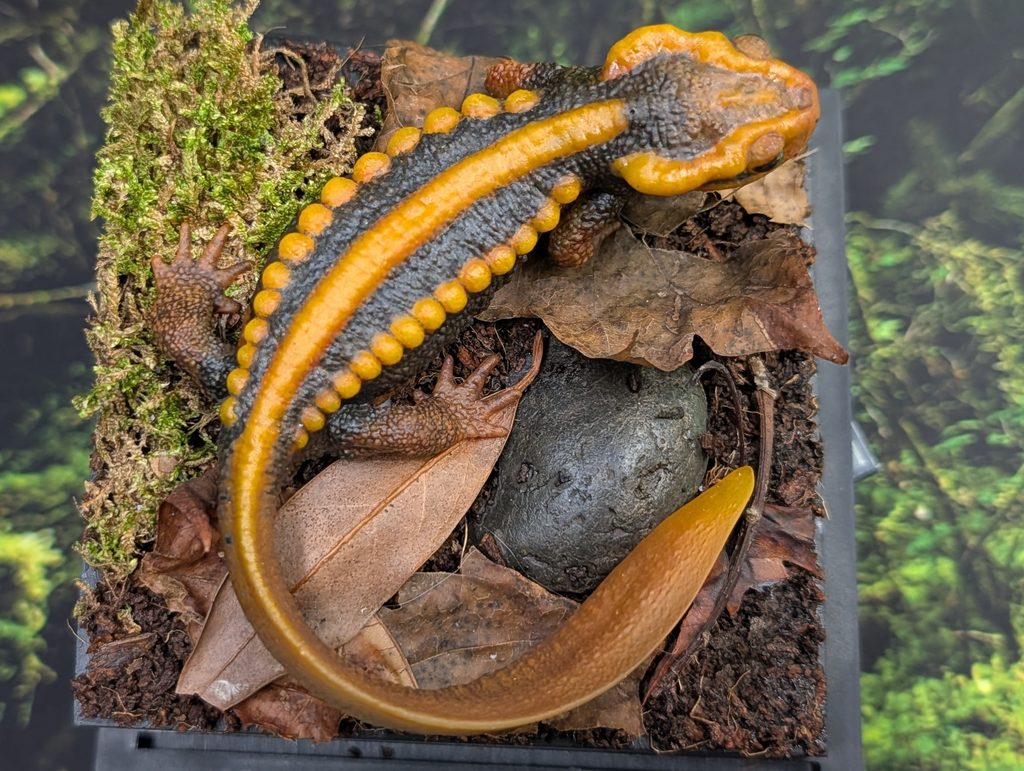
The tail is almost a dark amber colour, slight darker in the centre mass, although it might be that the fin is very slightly translucent, so look lighter (the first photo shows this to an extent). The eyes are very shiny, painted dark amber with a black pupil. There is also some faint orange wash on the top of the head, between the eyes. There is a similar wash under the throat and chest. The entire figure is painted, but I can’t see the actual underside as it is fixed to the base. I suppose I could detach it–but I don’t want to risk damaging anything!
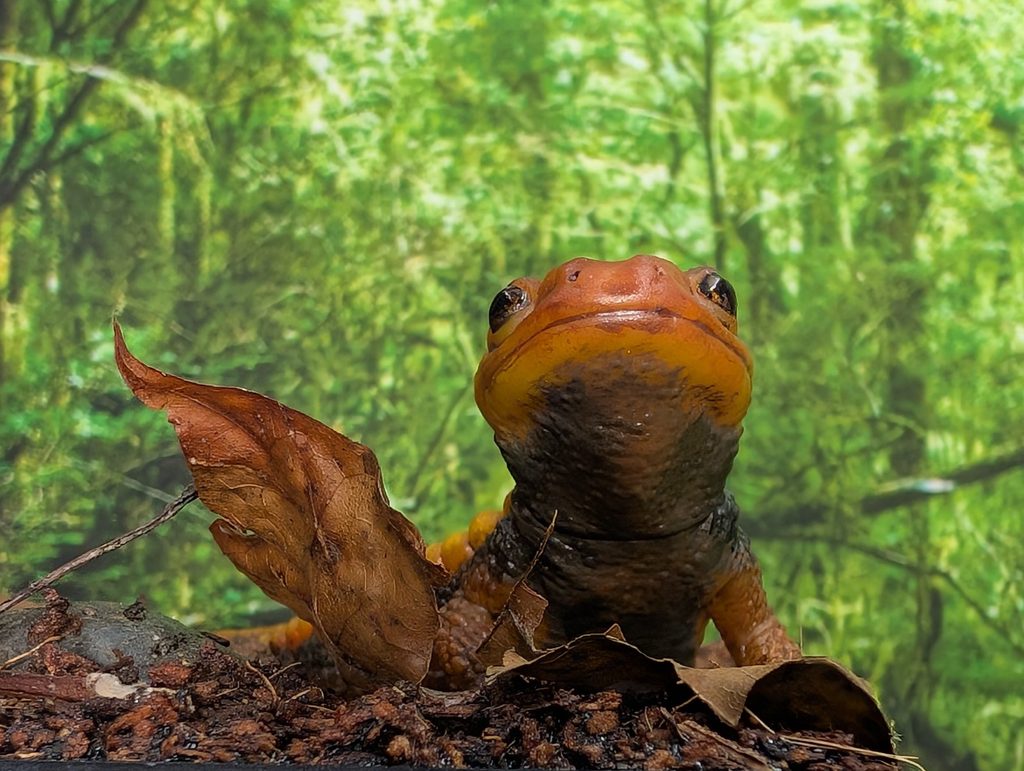
This figure might be one of the rarest things I have in my collection, and possibly the most realistic. If I stare long enough, I swear it sometimes looks like it might blink or breathe. Maybe not the spookiest animal—but it has the seasonal colours, and the lethal toxin to unwary predators. It would be nice if the figure were more accessible, or even better, if one of our great current toy companies accepted the challenge of making a decent figure of the emperor newt (and other newts and salamanders!) I also have to say, if you ever have the opportunity to get a Hellbender Museum original, do it. It’s worth it. There are a couple of similar species from Yowies and ChocoEgg sets, that were in the same genus as the emperor newt but now in Echinotriton, but they are not to this level. Here’s hoping it happens sooner rather than later!
 All articles on the Animal Toy Blog are written without the use of ‘AI’