


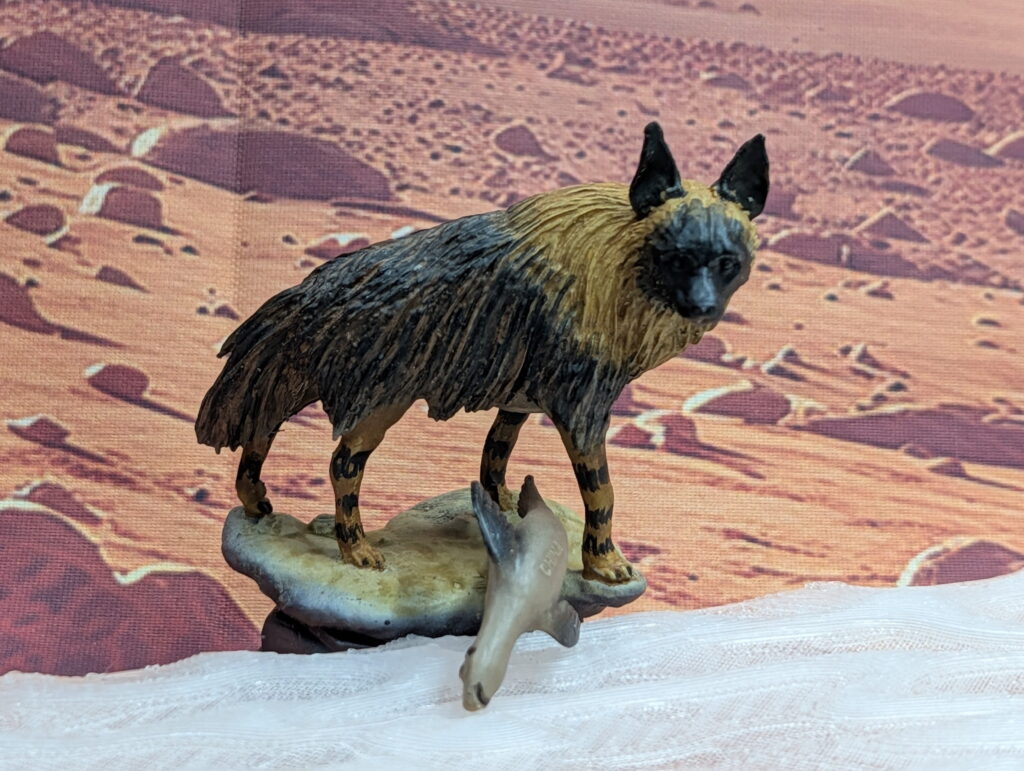
One more spooky entry from me this Halloween season, and it just happens to also crossover with one of my favorite animals to collect. Of course I’m referring to a hyena, and 2026 has been a wonderful year for hyena figures! Two new spotted hyena toys from Toymany (in the fantastic, must-have Carnivores set) and Safari Ltd (which I do like more than my review might suggest); as well as some more small-batch figures from the artist Tarit Kittikhun in Thailand under the name Tanimal—a set of the four hyena species, including the first aardwolf, all in a small, bottlecap-like size, and a larger brown hyena close to scale with the above spotted hyenas.
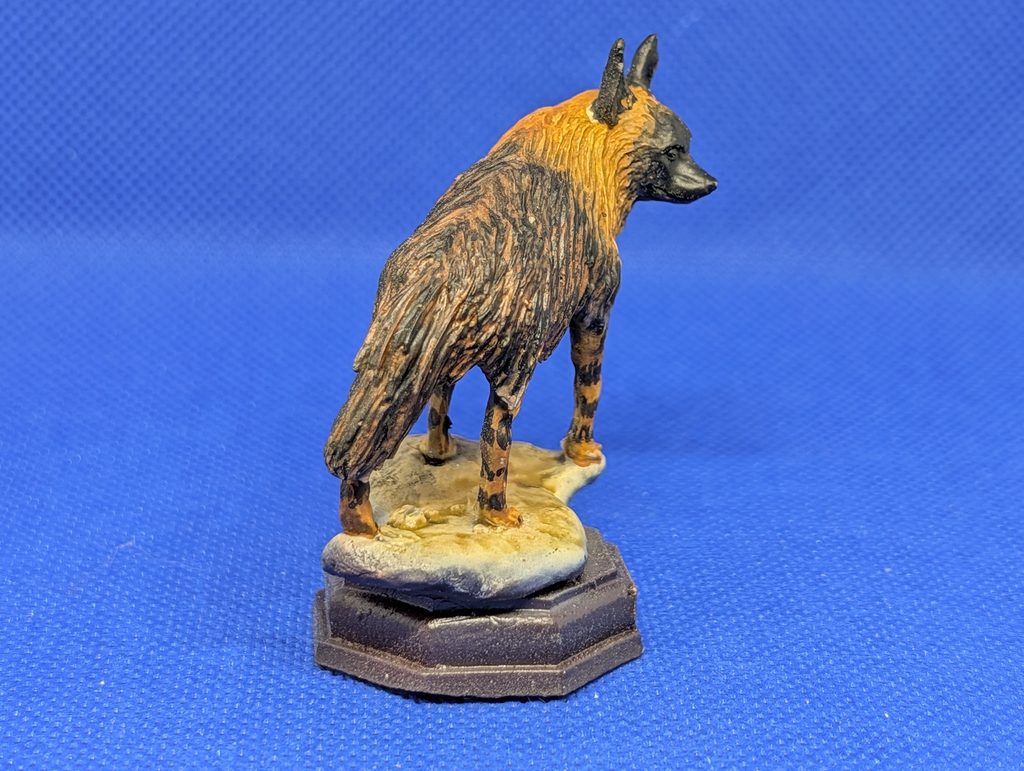
But how does today’s figure, a smaller version of the brown hyena Parahyaena brunnea figure into a spooky season? Well, on one hand, they are adapted to what seems like a rough life on the menacing-sounding Skeleton Coast of Namibia. An area also given names like “The Land God made in anger” (indigenous San people) or “The Gates of Hell” (the Portuguese). Sounds lovely. A name given for a large number of shipwrecks—and a beach that was once littered with seal and whale bones due to the whaling industry. But those seals are part of the reason brown hyena can survive there, because it’s one of the few places where they are active predators, specifically on fur seal pups.

But there’s another spectral connection for brown hyenas—this time last year, a photograph called “Ghost Town Visitor” won the Wildlife Photographer of the Year. For those who haven’t seen it here’s a link. Pretty haunting and atmospheric. Ghostly even! But I think does an excellent job of showing just how cool and majestic this particular species can be (yes, I’m biased). Also, it was probably on its way to hunt down seal pups if I understand the backstory correctly.

I already did a deep dive on the brown hyena thanks to the previous Tanimal figure, so I can skip a lot of that. The important parts, they are restricted to arid and grassland environments in southern Africa, where they are generally scavengers on carcasses and anything else edible. Plus, in one location, they will actively hunt seal pups on beaches. And there’s evidence of them scavenging on whales and other animals on those same beaches, giving them the Afrikaans name strandloper (“beach wolf”) which honestly sounds great and we should make it a thing. They are also mid-sized hyenas, standing about 70-80 cm (28-3 inches) at the shoulder.

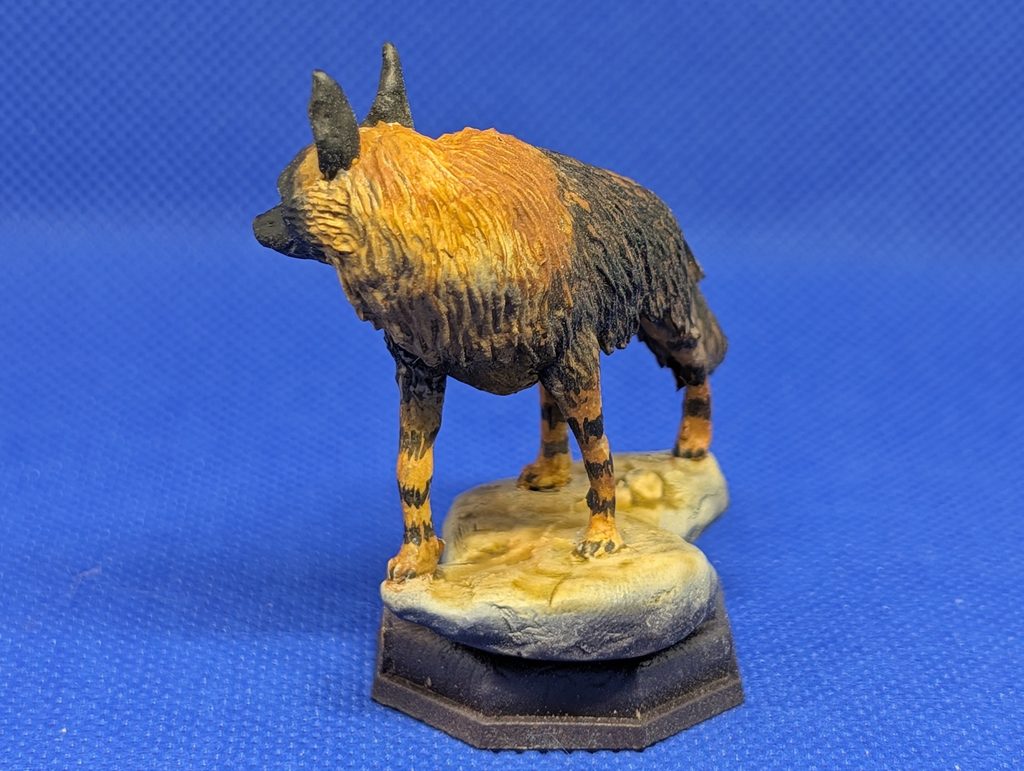
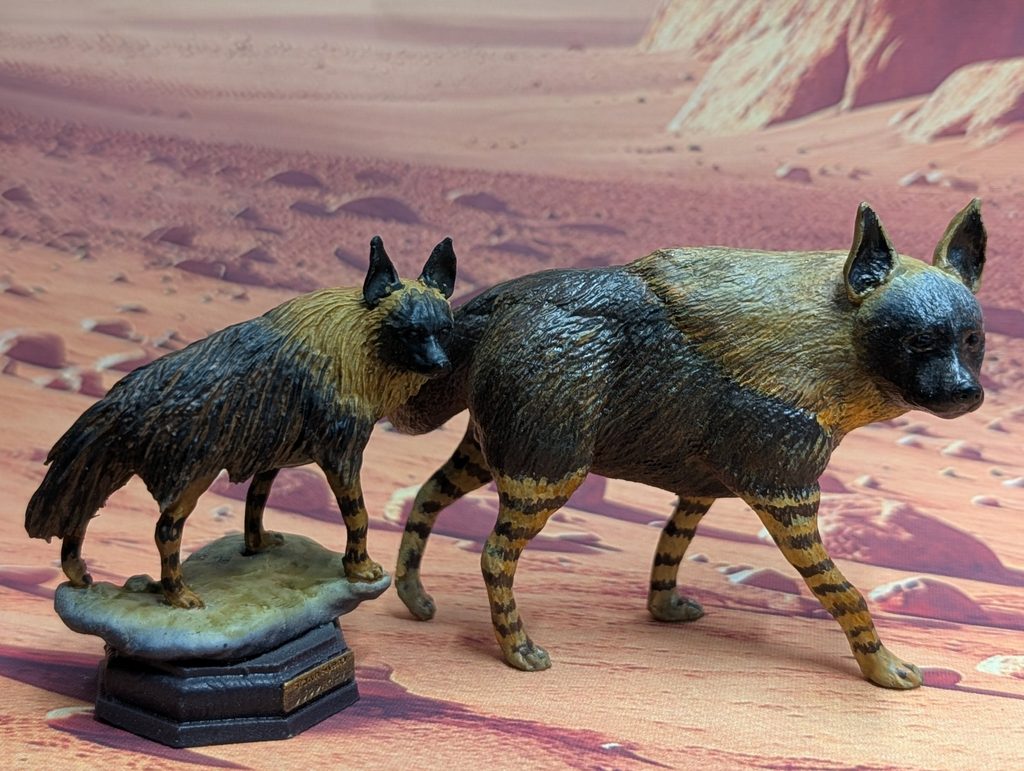
This figure, as mentioned, is a small one, in line with bottlecap and gashapon figures. It stands about 3.6cm (1.4 inches) at the shoulder, so we would be looking at a scale of about 1:19 to 1:22 (not far from the aardwolf figure, and all four figures are sort of close…I’ll get to the others eventually). It is depicted on the characteristic plinth base that Tanimal uses, standing on a small patch of rough sandy ground. Maybe it’s a beach? He (yup, it’s a male) is standing fully upright, striding with his head turned to the right. The back has a strong, obvious slope from the shoulders to the hip, and the legs are held in a parallel stride, common in desert animals.
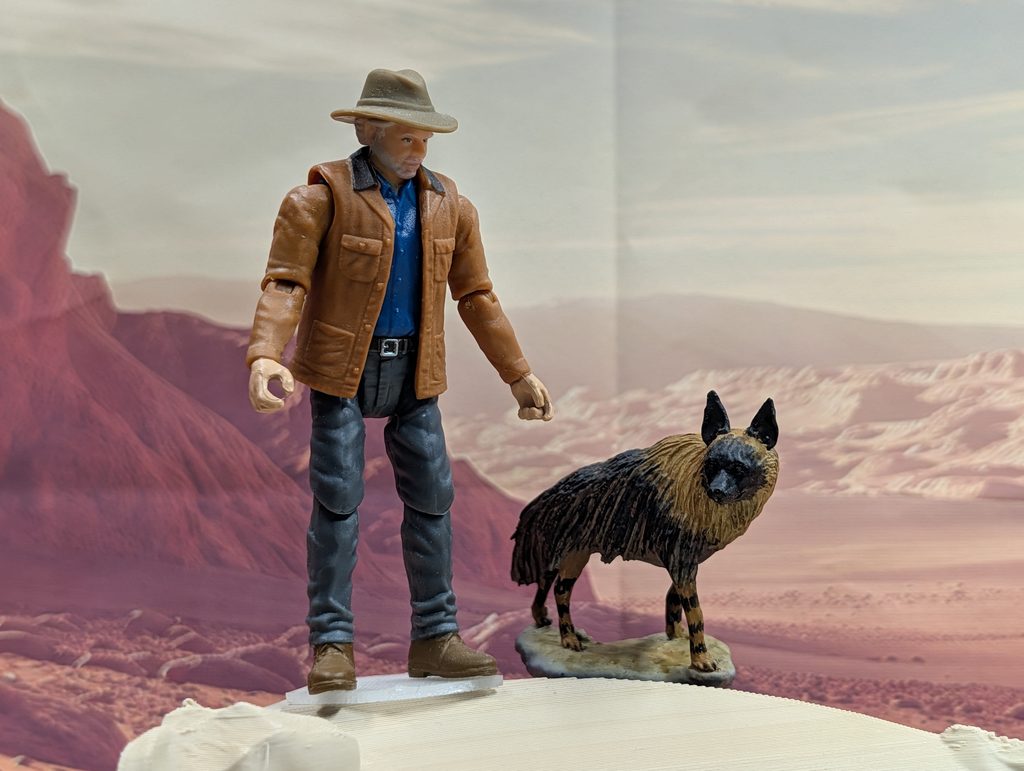
The majority of the body is actually the shaggy, long hair that forms the distinct mane of brown hyenas. It begins as a ruff and cape around the neck and shoulders, flowing back down the back and over the hips as a coat of thick, coarse hair. This hair has been depicted with great care, with distinct hair dividing down over the back, cascading down each side. The tail is also thick and shaggy, held low behind the rump, and swung slightly to the left and sculpted against the left leg. There are even small patches of hair from the cape that stick up and out over the base of the tail, a challenging feature to sculpt and cast. The cape also hangs down over the sides and giving extra shagginess.

The legs are long and skinny, held mostly straight. The rear left leg is slightly bent. Each foot is distinctly sculpted, each with four toes, a correct number for all hyenas. The underside of the figure is the only smooth part of the figure, difficult to see though, since it’s attached to the rocky base. The male genitalia is clearly sculpted on the figure, even more challenging to see given how far back under the hips and obscured by the cape that region is.

The head rounded, with the ears pointed straight up in defined points, a feature distinct from the striped and spotted hyenas, which tend to have some rounding to the tips. The forehead is squared with wrinkles, and drops down to a pointed, short muzzle. The eyes are rounded and sculpted as small round bulges, difficult to see due to the colours, but they are a shinier black. The jawline has a rough patch of fur up to the cheek. The mouth is held closed, with the mouth line present as a thin fold of jowl. The rhinarium is picked out carefully, with a small furrow down to the upper lip. The nostrils are tiny but present.
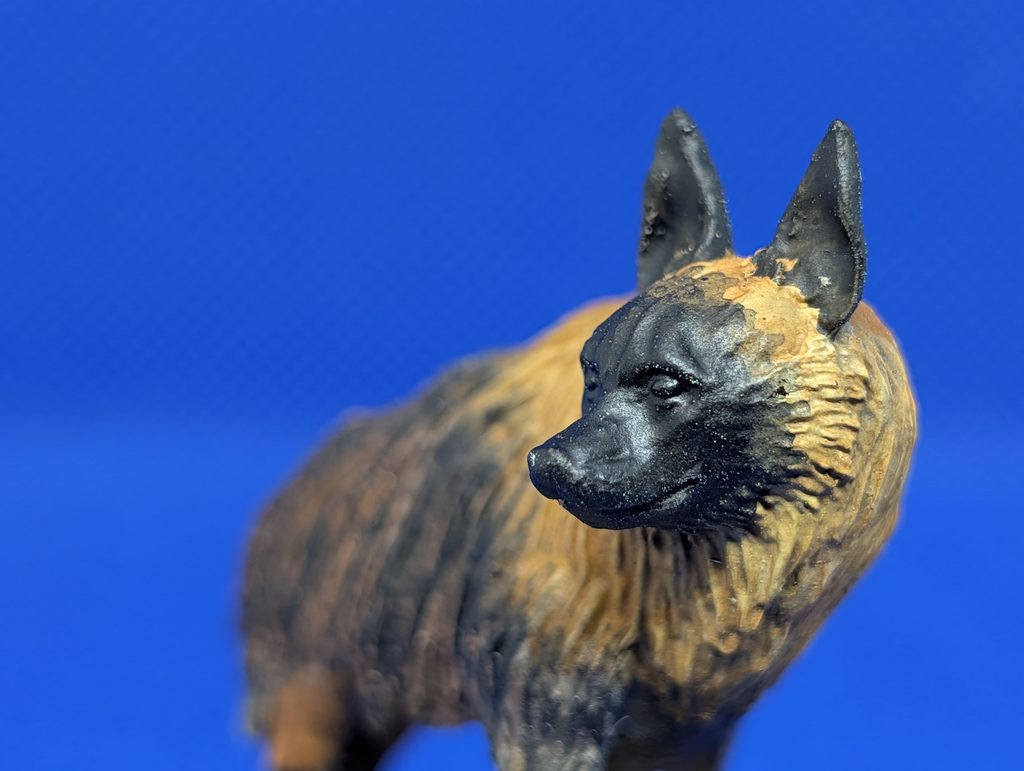
The colours on the figure are complex but very well-matched to the brown hyena patterns. The face is a flat black, with a semi-gloss finish. The eyes and rhinarium appear slightly shinier but still black. The ears are the same flat black. Ringing the face, and over the head, neck, and upper chest and shoulders, the mane is painted a yellow ochre, with a bit of a darker ochre wash over the back of the neck.


The underside is mostly brown with some black mixed in. The legs seem to be a bit darker than the neck, closer to a burnt sienna, ringed with black bands. There are black dots around the toes, but don’t appear to line up with the sculpted toes. The rest of the body and tail are painted with what appears to be a burnt sienna colour overlain with a heavy black wash that is present all the way down to the tips of the cape. There is a definite line between the lighter mane and cape, and the darker back and tail. From a glance, the overall colour appears to be brown, but up close the colours are more complex.

Maybe this figure is not particularly spooky itself, but their shy behaviour and nocturnal behaviour means that they aren’t often seen except in patience-taxing photographs. I don’t think they’re even all that common in captivity (but I will make it my mission to eventually see one somewhere). This figure is, in my opinion, a superior rendering of the brown hyena over the larger one from Tanimal. The shagginess alone is so much more exaggerated and just really captures that look. I would still recommend both, but this one would be my first pick (although the sculpt-attached base may be less attractive to some collectors).
 All articles on the Animal Toy Blog are written without the use of ‘AI’