


Back to spooky season and this one is a devilishly weird one. Pygmy devilishly really. It is another companion animal from the GI Joe Classified series by Hasbro. Unlike that reviewer, I grew up with the GI Joe 3.75” series, so I do dabble in the new 6” series with some old favorites (I do not, however, need all 200+). When I was a kid, my favorites were the ones with animal accessories (although oddly didn’t have the croc) and definitely remember the original version of this figure.

The character is called a Hydro-Viper, ‘Vipers’ being the name for the various Cobra special-skill operatives. Some of them seem like guys with cool uniforms, others appear to have been modified by ‘SCIENCE!” It was the 80s. As kids we didn’t question. Obviously, this is an underwater character and what better associated attack animal than a…small manta ray of some kind? It has been referred to as a devil ray, a name often given to the smaller species. And given that small size in a generally scaled series, the best guess would be a pygmy devil ray of some kind. This would be a first given that most manta figures are the giant species, which have been seen on the blog several times.

Working backward, the figure itself has a wingspan of about 8.2cm (3.2 inches) across. Scaling to the human figures with a scale of 1:12 (the given 6” scale for the series) to something more accurate like 1:11 (they don’t actually measure 6 inches, but are generally a little taller), that brings the ray figure to around 91 to 98 cm (36 to 38 inches) across. Definitely not the typically familiar giant mantas, but there are a few smaller Mobula species that can be mature in that range. The three smallest species are Mobula munkiana, Munk’s pygmy devil ray (although Fishbase lists something far larger, but no other source does), M. eregoodoo, the longhorned devil ray, and M. kuhlii, the shortfin devil ray, all of which average around 1.2 metres (47 inches) across.

I will be working from the assumption of the figure as the longhorned devil ray Mobula eregoodoo (sometimes referred to as M. eregoodootenkee) based on the proportions of the disc length to disc width (roughly 1:0.55 for the figure, 1:0.58 for the species), and the long cephalic horns. The stylization of the figure is not exactly accurate, so this is just an assumption! This species has a broad range throughout the Indo-Pacific and southwest Pacific ocean. They are a pelagic species, inhabiting the upper 50 metres of the water column. As with all Mobula species they are pelagic filter feeders, travelling in small groups up to 50, or as solitary individuals.

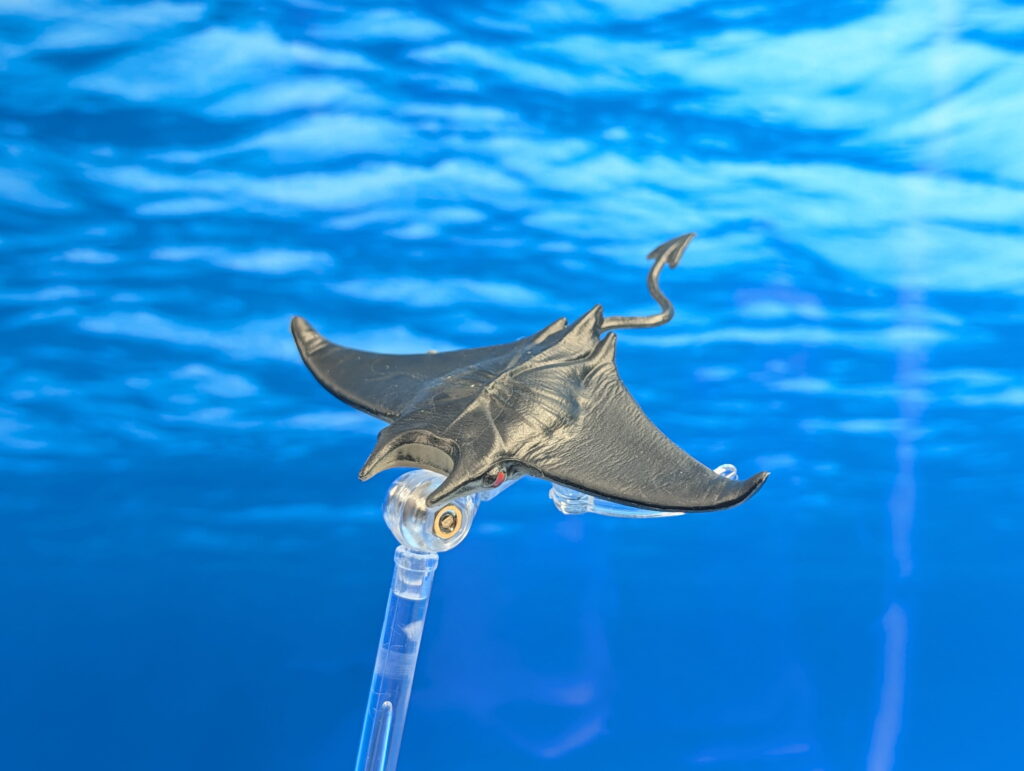
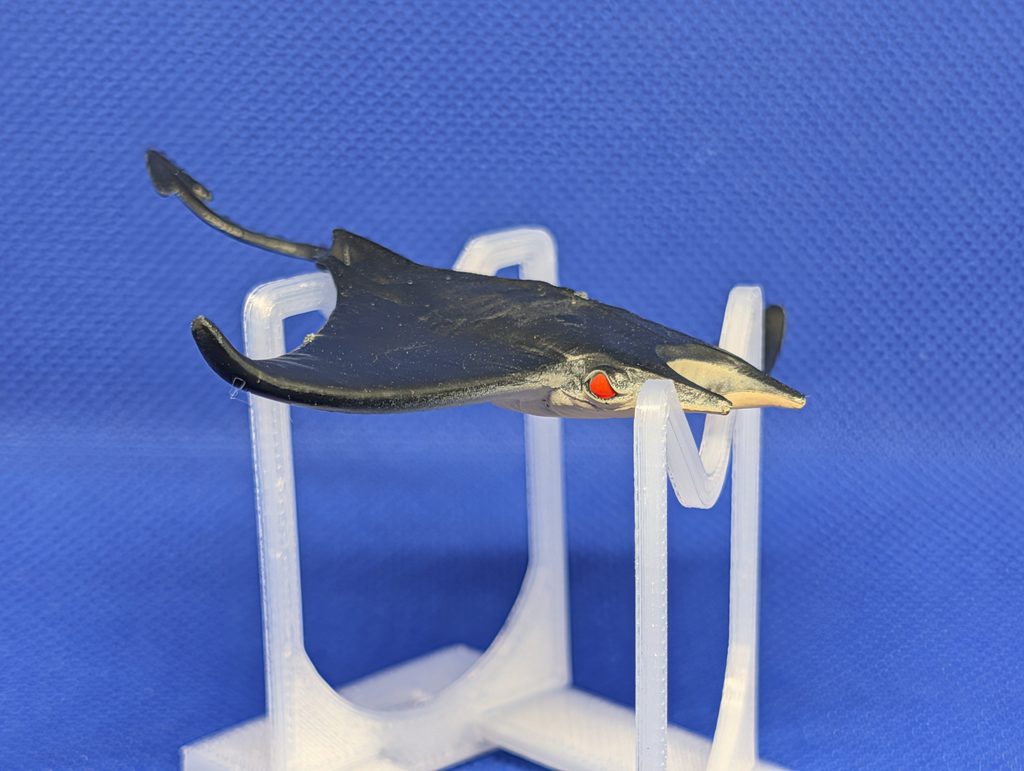
As mentioned, the figure itself is highly stylized and with a few glaring oddities but has a pretty general manta appearance. The main body is thickened but flat, tapered at the posterior end and squared at the anterior. Of course, the head has the two long ‘horns’ of the cephalic fins pointing straight forward, between them is a wide, oblong mouth. At least they resisted the usual urge to put teeth in the mouth. The horns are relatively long, appropriate for M. eregoodoo. On the outer base of each horn is a distinct, oblong eye, painted a villainous red. Villainous I say!

On the back are numerous ridged folds giving some texture. The posterior of the disc comes to a sharp point, with a thin fin underneath. It should be a bit more raised, but at least there’s no defensive spine. The dorsal fin is flanked but two other posterior points. They look like pelvic fins except they appear to originate off the top of the body so…yeah. Behind that of course is an extended thin tail. It’s mostly okay, except for the odd arrow-shaped tip. I think they took the ‘devil’ part of devil ray too literally. It could be easily removed if it bothered someone.

The broad wing-like pectoral fins are extended outward, slightly raised at the outer tips. There is a slight recurve on the posterior margin, with a gentle curve on the forward margin. There are some small folds around the outer tips, giving a bit of motion on the fins. The tips of the wings should also have a bit more of a recurve to them but being raised makes it unclear.

The underside of the pectoral fins are pretty smooth. As mentioned, there are no pelvic fins, which is wrong, but also no anal fin, which is correct. Also surprising, there is a distinct cloacal slit present before the tail. The body is also a bit thickened on the underside, making the distinction between the pectoral fin and body distinct. There are no wrinkles or folds, but there is a bit of a sculpted texture. Most notable are the large, distinct paired gills behind the mouth. They are deeply incised and expand from smaller at the front and larger at the back. It’s kind of surprising that an action figure accessory would get this right at least (we’ve all seen ‘better’ figures that mess this up).
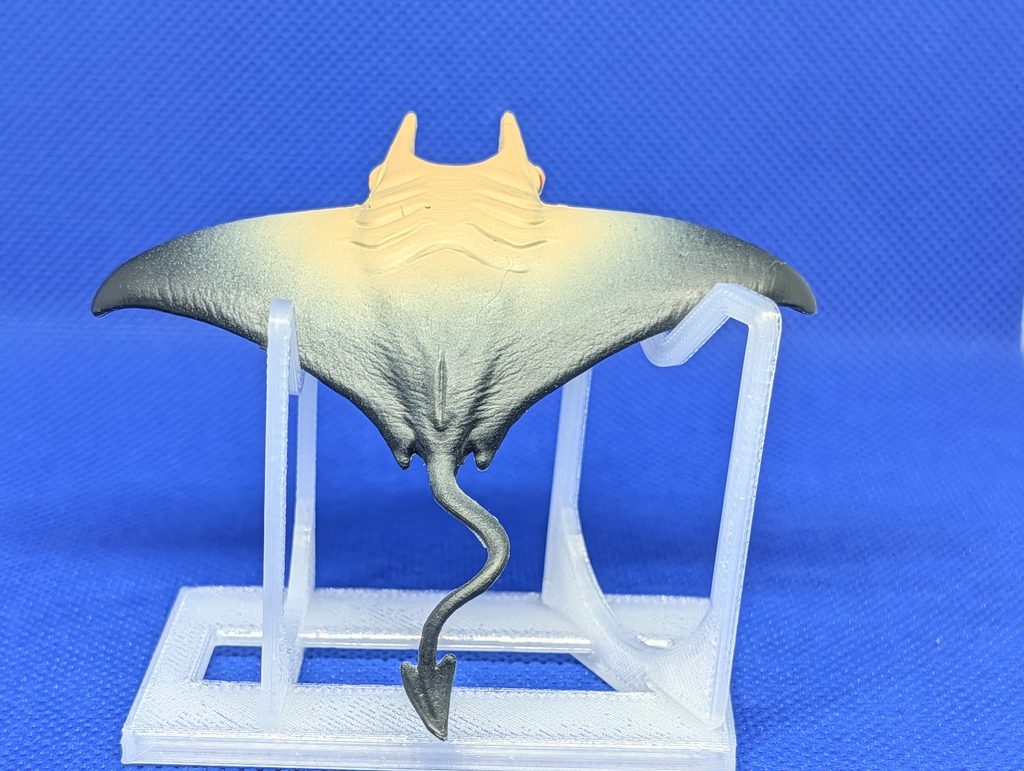
The colour of the figure is relatively simple, with the entire dorsal surface painted a matte, dull black. The underside has more elaborate colouring. The main colour is yellowish or ivory white over the gills and shoulder. The inside of the mouth and the cephalic horns are the same ivory colour. This colour then grades outward to the same matte back on the tips and posterior edges of the pectoral fins. The tail is entirely black. For the longhorned pygmy devil ray there should be a dark blotch on the leading edge of the pectoral fins but, again, heavily stylized figure.
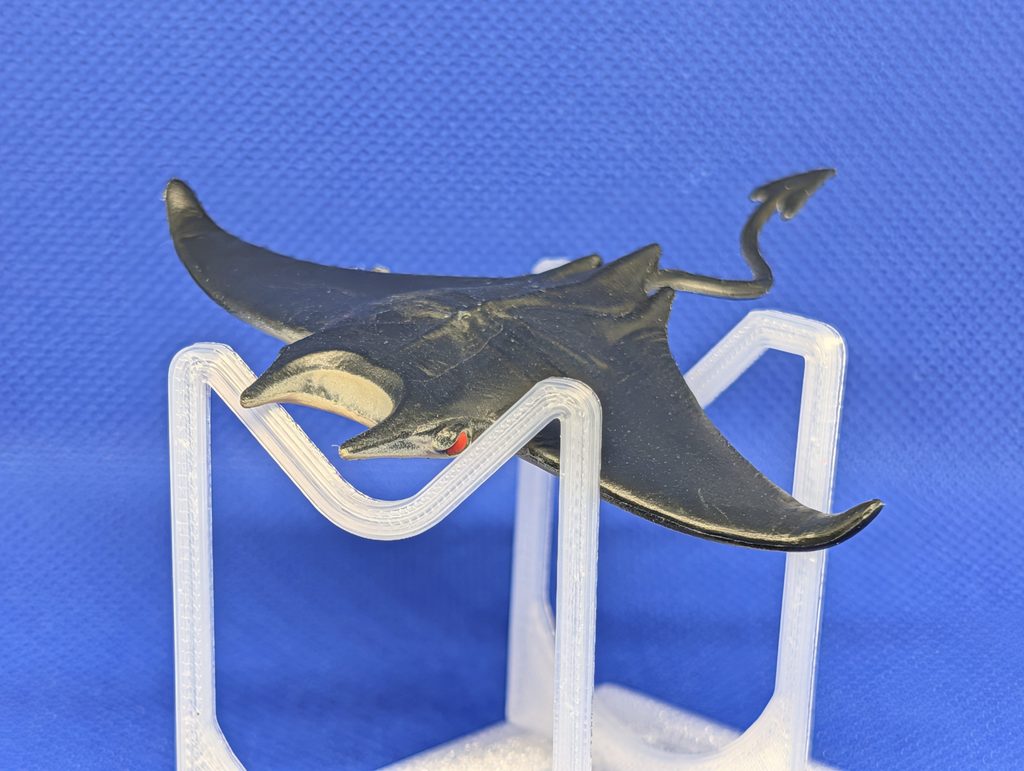
So overall, this is kind of a fun figure of a probable pygmy species of Mobula devil ray. It is somewhat surprising that even some of it is kind of accurate, given that GI Joe figures can be all over the place when it comes to the animal accessories (and were my favorite part of many of them back then!) If the size weren’t a factor, it could probably stand in for some other larger species as well, but it’s hard to ignore when it is associated with a human figure! I can say that they did a better job than the 3.75” version back in the 80s. That one had a really weird body shape with a similar scale to the human and, yes, teeth in the mouth. And the devilish arrow tail. In general, this isn’t a great manta/devil ray, but it amused me to use the ‘devil’ ray excuse during spooky season to review it!
 All articles on the Animal Toy Blog are written without the use of ‘AI’